Clicking Noise When Turning the Steering Wheel at Low Speed
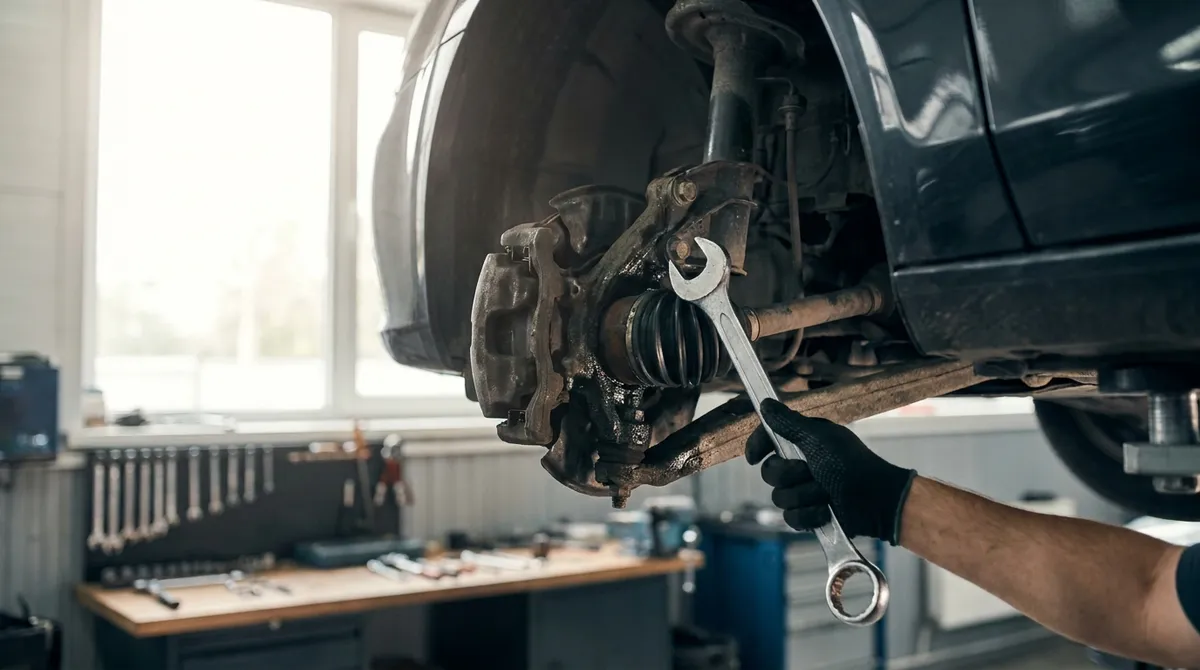
You’re pulling into a parking spot, backing out of the driveway, or just cruising slow through the neighborhood, and there it is: a distinct clicking or popping sound every time you turn the wheel. It’s not just annoying; it’s your car trying to tell you something. This particular noise, especially when it happens at low speeds and while turning, often points to a few specific parts in your car’s front end.
The Usual Suspect: CV Axles
When you hear a clicking or popping noise that gets faster with wheel speed, especially when turning, the first thing most mechanics think of is a bad Constant Velocity (CV) axle. Your CV axles are what connect your transmission to your wheels, allowing power to get to the ground while also letting the wheels move up and down with the suspension and turn left and right for steering.
Each CV axle has two CV joints, an inner and an outer. These joints are packed with grease and protected by a rubber boot. Over time, these boots can crack or tear. When that happens, the grease leaks out, and dirt, water, and road grit get in. This contamination grinds away at the joint, causing it to wear out. Once a CV joint starts to wear, it’ll often click or pop as the worn parts engage and disengage, particularly when the joint is under stress, like during a turn. The outer CV joint is usually the one that makes noise when turning because it’s doing more work in those situations.
Replacing a CV axle is a pretty common job. You generally replace the whole axle assembly, not just the joint, as it’s often more cost-effective. You can look up common fixes and part information in the MECH AI database.
Don’t Rule Out Other Front End Parts
While CV axles are the top contender, other components in your steering and suspension can also make similar noises. It’s worth checking them out, especially if the clicking isn’t perfectly consistent or sounds more like a clunk.
- Ball Joints: These connect your control arms to your steering knuckle, allowing the wheel to pivot. Worn ball joints can cause a clunking or popping noise, especially when going over bumps or turning. They can also lead to loose steering and uneven tire wear.
- Tie Rod Ends: Both inner and outer tie rod ends are crucial for steering. They connect your steering rack to the steering knuckle. If these wear out, you might hear a clunk or click, feel looseness in the steering wheel, or notice your alignment is off.
- Wheel Bearings: While a failing wheel bearing usually makes a humming or grinding noise that gets louder with speed, a severely worn bearing can sometimes cause a clicking or popping sound, especially if there’s significant play in the wheel. However, this is less common for a low-speed turning click.
- Loose Lug Nuts: This one’s simple but sometimes overlooked. If your lug nuts aren’t torqued down correctly, the wheel can shift slightly, causing a clicking sound. Always check these first after any wheel work.
If you’re unsure where to start, the AI Mechanic can walk you through diagnostic steps specific to your vehicle.
What You Can Check Yourself (Safely)
Before you take it to a shop, there are a few things you can safely inspect in your driveway.
- Visual Inspection for CV Boots: Park on a level surface, turn your steering wheel all the way to one side, then look behind the wheel. Use a flashlight. Look at the rubber boots on the CV axle shafts. Are they torn, cracked, or leaking grease? You might see black grease splattered on the inside of the wheel or fender well. Repeat for the other side.
- Listen Carefully: Drive slowly in a large, empty parking lot. Try making tight circles in both directions (figure-eights are great for this). Listen closely. Does the noise happen more when turning left or right? Does it get louder or more frequent with acceleration? This can help narrow down which side or which joint is the problem.
- Check for Wheel Play: This requires jacking up the front of the car safely and supporting it with jack stands. Never get under a car supported only by a jack. Once the wheel is off the ground, grab the tire at 12 and 6 o’clock and try to rock it. Then grab it at 3 and 9 o’clock and rock it. Any significant play could indicate a worn ball joint, tie rod end, or wheel bearing. A little bit of play in the 3 and 9 position is normal for some steering racks, but excessive play is a problem.
When It’s Time for a Pro
If you’ve done your checks and still can’t pinpoint the issue, or if you’re not comfortable getting under the car, it’s time to take it to a trusted mechanic. Suspension and steering components are critical for your safety. A professional shop has the right tools, like lifts and specialized pry bars, to properly diagnose worn components. They can also perform a more thorough inspection and confirm which part needs replacing.
While some DIYers can tackle CV axle or ball joint replacements, these jobs often require specific tools (like a torque wrench for axle nuts or a ball joint press) and a good understanding of suspension work. Sometimes, paying for a shop’s diagnostic fee makes a lot of sense, especially when you’re dealing with a mystery noise that could be several different things. Read more about when a diagnostic fee is worth it.
Ignoring a clicking noise won’t make it go away, and it’ll usually just get worse. Get it checked out before a small repair turns into a bigger headache or, worse, a safety issue.